Dataset Rich Results
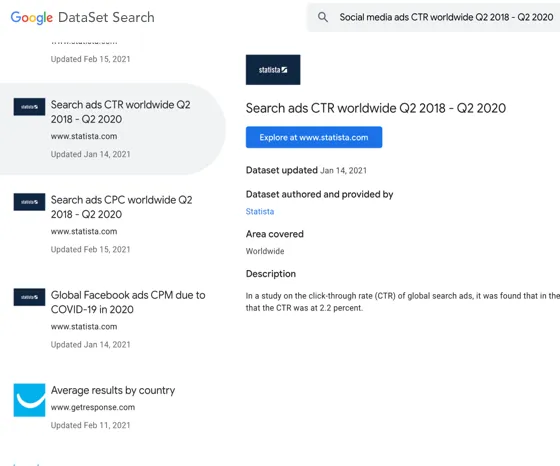
This markup is intended to create ease for finding datasets relating to civic and government data, life sciences, social sciences, and more within Google’s Dataset Search Tool. It should describe the datasets information and represent the contents of the dataset.
Below are Google’ examples of datasets that qualify for this structured data markup:
- A table or a CSV file with some data
- An organized collection of tables
- A file in a proprietary format that contains data
- A collection of files that together constitute some meaningful dataset
- A structured object with data in some other format that you might want to load into a special tool for processing
- Images capturing data
- Files relating to machine learning, such as trained parameters or neural network structure definitions
- Anything that looks like a dataset to you
What does your website need?
- Description: text that describes in 50 – 5000 characters a summary of the dataset
- Name: a descriptive name of the dataset
There are many other properties that can be added to the dataset markup and are recommended by Google if they are applicable. Below is a list of additional properties that will assist in the accessibility of the dataset.
- alternateName: another name that the dataset may be referred to as
- Creator: the author of the dataset
- Citation: articles in which the dataset is supplementary for
- isPartOf: if the dataset is the larger set of smaller datasets this property will denote the relationship between multiple datasets
- Identifier: a DOI or Compact Identifier
- Keywords: focus keywords of the dataset
- License: which the dataset is distributed under
- spatialCoverage: the area in which the data was collected
- temporalCoverage: the time period in which the data was collected
- variableMeasured: the particular variable, such as temperature, that was measured
- Version: the number of the dataset’s version
- Url: the page in which the dataset is described
- DataCatalog: the data catalog/repository that the dataset belongs to
- DataDownload: signifies that the data is downloadable and a link to the download