Canonicalization SEO: Ensure Google Prefers Your Content
Canonicalization is the process of telling search engines which URL on your site is the definitive version of a page, and Huckabuy Technical SEO automates it so your rankings, link equity, and generative engine visibility never fragment across duplicate URLs. Search engines experience website content differently than humans: for them, every unique URL is a separate page. When a single page is accessible by multiple URLs with similar content, Google treats them as duplicates and picks one to index as the original. Sometimes it picks the wrong one — which is why you should proactively tell it which URL is which.
WHAT ARE CANONICAL TAGS?
A canonical tag is a snippet of HMTL code that defines the main version from duplicate or similar pages. It looks like the following: link rel = "canonical" href = "example.com". "link rel" means this link is the master version of the page and "href = example.com" means the canonical version can be found at the specified url.
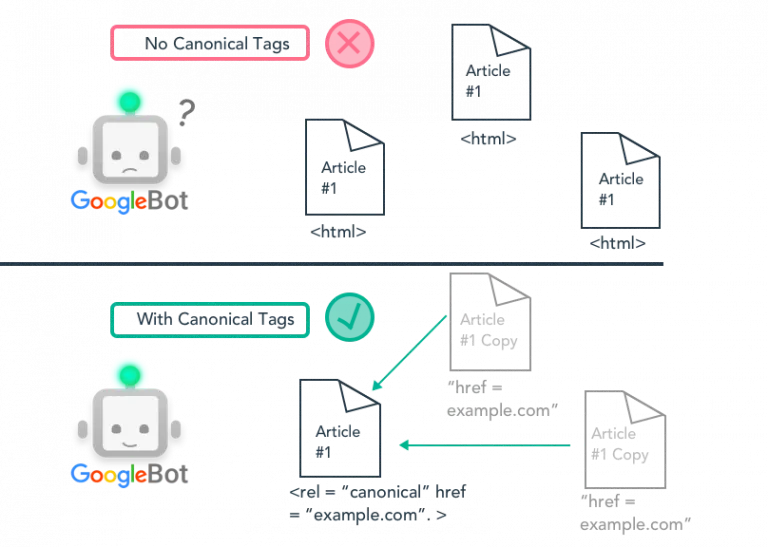
The canonical tag was introduced by the major search engines in 2009 as a way for webmasters to solve duplicate content issues and preserve link equity and rankings by specifying which version should be indexed to appear in search results. It's like the technical SEO form of an academic citation. In the same way you cite a source on a research paper to avoid plagiarism, you use a canonical tag to prevent duplicate content penalties among similar URLs.
WHY IS CANONICALIZATION GOOD FOR SEO?
On a high level, canonicalization is good for SEO because it helps Google make sense of duplicate content and minimizes the risk that they pick the wrong URL as the canonical version. With canonical tags in place, Google can correctly consolidate link equity, index, and rank the main version of your content for relevant queries. It also helps preserve crawl budget so they have more time to spend discovering other important areas of your website.
CANONICALIZATION IN THE AGE OF AI AND GEO
A correct canonicalization strategy is the non-negotiable foundation for Generative Engine Optimization (GEO). AI crawlers, including Google-Extended and GPTBot, require a single, unambiguous source of truth to build their knowledge graphs. Without a clear rel="canonical" signal, you risk fragmenting your authority across duplicate URLs, a common issue affecting a significant portion of the web. In fact, Semrush's 2025 duplicate content guide explains how duplicated URLs dilute backlink power and waste crawl budget, leaving the wrong version of your content visible. This ambiguity makes your content a less reliable candidate for citation in Google AI Overviews and other AI-powered answers. It directly undermines your ability to become an authoritative source. Huckabuy's automated technical SEO platform resolves these canonical conflicts at scale. It ensures every page sends a single, authoritative signal to both traditional search engines and generative AI, preserving your crawl budget and maximizing your visibility in the new era of search.
The stakes for correct canonicalization have escalated with the rollout of Google's Search Generative Experience. AI models require unambiguous signals to build their knowledge graphs. A single canonical error can fragment authority and confuse these systems. This is not a theoretical problem: a September 2025 Seer Interactive study found that organic CTR on informational queries with Google AI Overviews fell from 1.76% to 0.61% — a 61% decline since mid-2024 — meaning visibility is shifting from the classic results list to generative answers, where an ambiguous source of truth can de-prioritize your content entirely. This technical debt directly limits a brand's visibility in generative answers. Huckabuy's automated approach to technical SEO eliminates this risk by ensuring every page sends a single, authoritative signal, preserving crawl budget and maximizing the potential for AI citation.
A flawed canonical strategy directly undermines your ability to be a cited source in generative AI answers. This is not a minor technical detail. Ahrefs' 2026 SEO statistics analysis found that 95.2% of websites have at least one 3XX redirect issue — and every redirect chain is a decision point where the canonical signal can drift out of sync, diluting the authority that search engines and AI systems attribute to your content. For large language models, this level of ambiguity is a critical failure. LLMs from Google and OpenAI rely on unambiguous signals to build their knowledge graphs and determine a definitive source of truth. Without a single, authoritative URL consolidated via a correct rel="canonical" tag, all ranking signals—including backlinks and user engagement—become fragmented. This dilution makes your content a less reliable candidate for citation in AI-generated search results. This principle is the core of the Huckabuy Authority Flywheel. It ensures that the technical foundation of your website, including perfect canonicalization, directly translates into higher authority and visibility within generative engines, a key component of a modern Generative Engine Optimization strategy.
WHAT ARE THE BEST PRACTICES FOR CANONICALIZATION?
Here is some advice to consider when starting out:
- Use the URL Inspection Tool in Google Search Console to see which page Google considers to be the canonical version.
- When deciding between using a redirect or canonical tag, go with the redirect unless the user experience would be diminished in some way.
- When choosing which page to use the canonical tag on, go with the version you think is the most important. A good proxy is the URL with the most links and traffic.
- The canonical tag should only be used for identical or near identical URLs. It is not to be used for topical grouping.